
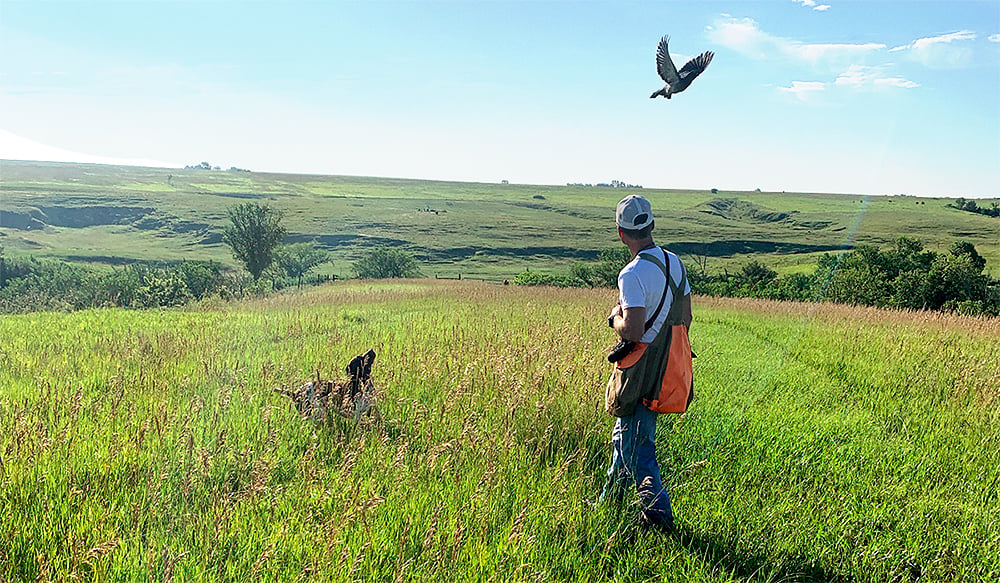
How to Match the Right System to Your Dog, Your Terrain, and the Training Season Ahead
A dog that will handle a wild rooster in standing corn at 300 yards, hold steady on a covey rise, or stop cold on a whoa in sharptail country is not born that way. That dog is built in the yard, over months, before a bird enters the picture. The e-collar is the tool that makes those commands hold at distance and under distraction. Buy the right one now, before the training season gets away from you, and you have a real window to build something before opener.
Dogs Unlimited carries five brands of electronic training collars: Garmin, SportDog, Dogtra, DT Systems, and E-Collar Technologies. Each one does something better than the others. The right brand depends more on how you train, what you hunt, and what your dog needs than on brand loyalty.
Quick Answer
- Tri-Tronics-based system, multiple dogs on one transmitter: Garmin Pro 70 System (6 dogs, 1 mile)
- Tri-Tronics-based system, vibration and 21 stimulation options: Garmin Pro 550 System (3 dogs, 1 mile)
- Tri-Tronics-based system, hound dogs and maximum range: Garmin Pro Trashbreaker (9 dogs, 4 miles)
- Close-working flushing dogs in tight cover: SportDog FieldTrainer 425X or Dogtra CUE GEN2
- Pointing dogs on open ground: SportDog SportHunter 1825X or Dogtra 1900X Black Edition
- Waterfowl retrievers: SportDog WetlandHunter 1825XCAMO or DT Systems H2O series
- Upland pointing dogs with integrated beeper: Dogtra 2700 T&B (1 mile), Dogtra T&B Dual (1.5 miles), DT Systems R.A.P.T. 1450 Upland, or SportDog Upland Hunter 1875
- Precise stimulation control for sensitive breeds: E-Collar Technologies ET-300 Mini Educator or Dogtra ARC-X
- Training and GPS tracking in one system: Garmin PRO 550 Plus
- Pet owners and obedience-focused training: Dogtra CUE GEN2 or E-Collar Technologies ET-300 Mini Educator
Before You Shop: What an E-Collar Actually Does
An e-collar is a reinforcement tool, not a teaching tool. It reinforces commands a dog already understands on a leash and in low-distraction conditions. A dog that does not respond reliably to a recall in the yard will not respond reliably at distance in the field with a collar on its neck. The e-collar makes known commands work at distance, under distraction, and in hunting conditions where a leash is not an option. It does not replace the obedience foundation. Build that first.
Every system in this guide delivers stimulation through contact points pressed against the dog's neck. The transmitter in your hand sends a radio signal to the receiver on the collar, which delivers tone, vibration, or static stimulation. The stimulation is brief, adjustable, and controlled by the handler. Used at the right level for the individual dog, at the right moment in training, it is one of the most precise communication tools available.
The Decision Framework: What to Figure Out Before You Buy
How Far Does Your Dog Range?
This is the first question, and it determines your minimum range requirement. A Boykin Spaniel quartering quail cover rarely pushes past 200 yards. An English Pointer on a sharptail lease in North Dakota can be a half mile away before you know it. Size your system to the farthest your dog actually goes in the country you actually hunt.
Like GPS systems, e-collar range is measured under ideal conditions: open, flat ground with unobstructed line of sight between transmitter and receiver. Dense timber, rolling hills, and heavy cover all reduce effective range. For a full explanation of how radio signals behave in terrain, see our GPS tracking range guide. The same principles apply to e-collar range.
How Sensitive Is Your Dog?
Stimulation level range matters more than most hunters consider when buying a first collar. A dog's response to stimulation varies with drive, excitement level, and distraction. A dog that responds at level 3 in the yard may need level 6 in a bird field. Systems with more levels give you more precision to find and hold your dog's working level without jumping over it. This is particularly important with breeds that vary widely in temperament from dog to dog — German Shorthaired Pointers, Labrador Retrievers, and Vizslas among them.
Do You Need a Beeper Integrated?
Some systems integrate a beeper directly into the collar receiver, eliminating a separate beeper collar. This matters for pointing dog hunters who want to hear a point without looking at a screen. The Dogtra 2700 T&B, DT Systems R.A.P.T. 1450 Upland, and SportDog Upland Hunter 1875 all combine training and beeper in one receiver. If you already run a dedicated beeper collar, a standard e-collar without beeper function is the simpler setup.
How Many Dogs Are You Running?
Most systems in this guide expand to at least 3 dogs with add-on receivers on the same transmitter. The Garmin Pro 70 handles 6 dogs. The Garmin Pro Trashbreaker handles 9. The SportDog SportHunter 1825X expands to 6. If you regularly run a large string, multi-dog capacity affects the choice.
Waterproofing: What Are Your Conditions?
All collar receivers in this guide are waterproof. Transmitter waterproofing varies. If you hunt waterfowl, wade streams regularly, or hunt in heavy rain, a waterproof transmitter matters. The DT Systems H2O series includes a floating transmitter built for wet conditions. The SportDog WetlandHunter series is purpose-built for the duck blind. For dry upland work, standard water resistance is adequate.
The Brands and Where They Fit
Garmin PRO Series Built on Tri-Tronics Technology
Garmin's dedicated e-collar lineup is built on Tri-Tronics technology. The Pro 70, Pro 550, and Pro Trashbreaker all use the classic tubular transmitter design that Tri-Tronics users have known for decades, the same layout, the same dial logic, the same feel in the hand. If you spent years running Tri-Tronics and are stepping into a new system, the Garmin PRO series is where that muscle memory transfers. The electronics are updated; the interface is not.
The three systems target different use cases. The Pro 70 runs up to 6 dogs on one transmitter at 1 mile with 6 levels of continuous stimulation. The Pro 550 steps up to 21 total stimulation options across 7 dial settings, each offering low, medium, and high, and adds vibration and momentary correction alongside continuous. It supports 3 dogs at 1 mile. The Pro Trashbreaker is the outlier: 4 miles of range and 9 dogs on one transmitter, built for hound hunters who need to reach a dog going as far as it wants to go. The PRO 550 Plus adds GPS tracking to the training collar platform and is covered in the GPS section below.
One note: none of the Garmin PRO systems are compatible with legacy Tri-Tronics collars. The design is familiar; the electronics are not interchangeable.
Source: Pro 70 range (1 mile) and stimulation levels (6, continuous only) per garmin.com product page. Note: Garmin Pro 70 Owner's Manual spec table lists 2-mile wireless range; garmin.com uses 1 mile as the practical consumer figure. Pro 550 dial settings (7, each with low/medium/high = 21 total stimulation options) per Garmin Pro 550 Owner's Manual, model 010-01202-00 (garmin.com/manuals). Pro Trashbreaker range (4 miles), stimulation levels (6, continuous only), and 9-dog capacity per Garmin Pro Trashbreaker Owner's Manual (static.garmin.com/pumac/Pro_Trashbreaker_OM_EN.pdf). Note: the Garmin Upland Beeper, previously compatible with the Pro 550 and PT 10 collar, has been discontinued. Garmin has not released a replacement.
Pros
- Tubular transmitter design familiar to Tri-Tronics users across the full lineup
- Pro 550 offers 21 total stimulation options with vibration, momentary, and continuous correction
- Pro Trashbreaker reaches 4 miles, more range than any other system in this guide
- Pro Trashbreaker supports 9 dogs on one transmitter
- PRO 550 Plus bridges dedicated e-collar and GPS tracking in one system
- IPX7 floating handheld across the lineup
Cons
- Pro 70 and Trashbreaker offer 6 levels of continuous correction only, no momentary or vibration
- Not compatible with legacy Tri-Tronics collars despite similar transmitter design
Garmin PRO Series Models at a Glance
| Model | Range | Levels | Max Dogs | Best For |
|---|---|---|---|---|
| Pro 70 System | 1 mile | 6 | 6 | Multi-dog upland training, Tri-Tronics familiar handlers |
| Pro 550 System | 1 mile | 7 dial / 21 total | 3 | Pointing dogs, vibration, momentary and continuous |
| Pro Trashbreaker | 4 miles | 6 | 9 | Hound dogs, maximum range |
| PRO 550 Plus | 2+ miles | 18 | 3 | Upland hunting with GPS tracking |
Source: Range and stimulation level figures per garmin.com product pages and owner's manuals as noted above. PRO 550 Plus range per garmin.com consumer product page.
SportDog Best Value for Hunting Applications
SportDog builds collars specifically around hunting scenarios. The lineup is organized by hunting application rather than range alone. The FieldTrainer and SportHunter series cover upland work from close cover to open ground. The WetlandHunter series is built for the duck blind. The Upland Hunter 1875 combines e-collar training and a beeper in one receiver. All X-Series remotes are designed for no-look operation: the dial and buttons can be operated without taking your eyes off the dog, which matters when you are watching a flush or marking a bird.
The entire X-Series uses 21 levels of static stimulation along with tone and vibration, submersible to 25 feet via DryTek technology, and lithium-ion batteries with a 2-hour quick charge. Systems expand to additional dogs with Add-A-Dog receivers on the same transmitter.
Source: Range, stimulation levels, waterproof depth, and multi-dog capacity per sportdog.com product pages: FieldTrainer 425X, SportHunter 825X, SportHunter 1225X, SportHunter 1825X, WetlandHunter 425X, WetlandHunter 1825XCAMO, Upland Hunter 1875.
Pros
- Purpose-built lineups for upland, waterfowl, and hound hunting
- No-look remote operation across the full X-Series
- Strong price-to-performance ratio across the lineup
- DryTek waterproofing to 25 feet on all X-Series
- Upland Hunter 1875 integrates beeper and e-collar in one system
Cons
- 21 stimulation levels, less precision than Dogtra or E-Collar Technologies
- WetlandHunter 425X tops out at 500 yards, close-working waterfowl dogs only
SportDog Models at a Glance
| Model | Range | Levels | Max Dogs | Best For |
|---|---|---|---|---|
| FieldTrainer 425X | 500 yards | 21 | 3 | Close-working dogs, tight cover |
| SportHunter 825X | 1/2 mile | 21 | 3 | Moderate range upland |
| SportHunter 1225X | 3/4 mile | 21 | 3 | Mid-range upland and retriever work |
| SportHunter 1825X | 1 mile | 21 | 6 | Open country, multiple dogs |
| WetlandHunter 425X | 500 yards | 21 | 3 | Waterfowl, close work |
| WetlandHunter 1825XCAMO | 1 mile | 21 | 6 | Waterfowl, big water |
| Upland Hunter 1875 | 1 mile | 21 | 3 | Pointing dogs, integrated beeper |
Source: All range and capacity figures per sportdog.com product pages.
Dogtra Best Stimulation Precision
Dogtra builds collars around a rheostat dial that moves through stimulation levels in small, precise increments. Where SportDog offers 21 levels, Dogtra's field collars offer 100 to 127 levels, giving handlers the ability to find and hold an individual dog's working level with a degree of precision that matters when training sensitive breeds or working at very low stimulation. Contact points are designed to maintain consistent skin contact through heavy coats and wet conditions. IPX9K is Dogtra's highest waterproof rating, the top level of waterproof certification on the IPX scale.
The 2700 T&B is Dogtra's dedicated upland hunting system, combining e-collar training and an integrated beeper in a single receiver. The beeper horn faces downward so it clears cover and fence wire without snagging. Three modes — Run/Point, Point Only, and Locate — along with an Accelerometer sensor that reads actual dog movement, tell a handler what the dog is doing without checking a screen. At 127 stimulation levels and 1 mile of range, it covers the full spectrum of pointing dog hunting scenarios. The T&B Dual extends that to 1.5 miles with a dual-dial OLED transmitter and dedicated controls per dog, which eliminates toggling between dogs when running a brace.
The CUE GEN2 is a separate tool. It is not a hunting collar. It is designed for obedience-focused training with dogs of any temperament, which makes it useful for pet owners and for hunters who want a close-range yard work system without running a full field collar in training sessions.
Source: Range, stimulation levels, beeper modes, Accelerometer sensor, and waterproof rating per dogtra.com product pages: 1900X, 1900X Black Edition, ARC-X, CUE GEN2, 2700 T&B, 2702 T&B, T&B Dual. ARC-X 30% slimmer than 1900X per dogtra.com X-Series compatibility blog (dogtra.com/blogs/training-blog/x-series-model-compatibility).
Pros
- 127 levels across the field lineup for precise stimulation control
- IPX9K waterproof rating, the highest on the IPX scale
- 2700 T&B integrates beeper and e-collar with downward-facing horn that clears cover
- T&B Dual extends to 1.5 miles with dedicated controls per dog on one transmitter
- ARC-X is 30% slimmer than the 1900X, a better fit for smaller breeds
- CUE GEN2 purpose-built for obedience training and pet owners
Cons
- Standard 1900X and ARC-X top out at 3/4 mile, may not be enough for big-running pointing dogs without stepping to the Black Edition or 2700 T&B
- CUE GEN2 range is 400 yards, limited to close-range training only
Dogtra Models at a Glance
| Model | Range | Levels | Best For |
|---|---|---|---|
| CUE GEN2 | 400 yards | 99 | Pet obedience, close-range yard work |
| ARC-X | 3/4 mile | 127 | Sensitive breeds, slim collar profile |
| 1900X | 3/4 mile | 100 | Hard-working gun dogs, retrievers, 35 lbs+ |
| 1900X Black Edition | 1 mile | 100 | Open country, maximum range with Dogtra precision |
| 2700 T&B | 1 mile | 127 | Pointing dogs, integrated beeper, Run/Point, Point Only, Locate |
| T&B Dual | 1.5 miles | 127 | Two pointing dogs, dedicated dial per dog |
Source: All range and stimulation levels per dogtra.com product pages.
DT Systems Best for Upland Integration
DT Systems has been building electronic training collars since 1983. Their collars run lighter than comparable SportDog or Dogtra units, which matters on smaller dogs or dogs that carry a collar all day. The R.A.P.T. series transmitter has a patented curved design with a SureGrip strap that secures the unit to the back of your hand, allowing hands-free operation during training drills, hunt test lines, or any situation where you need quick access without fumbling for a transmitter.
The R.A.P.T. 1450 Upland is the standout for pointing dog hunters. It adds a fully integrated beeper with Run/Point, Point Only, and Manual Locate modes to the base 1400 training system, audible up to 450 yards. Each dog in a multi-dog setup gets its own numbered beeper tone, so you can tell which dog is standing without looking at a screen. The H2O series addresses waterfowl conditions with a floating transmitter built around wet-environment retriever training.
Source: Range, stimulation levels, beeper specifications, and transmitter design per dtsystems.com product pages: R.A.P.T. 1400, R.A.P.T. 1450 Upland, H2O 1820 Plus, H2O 1850 Plus.
Pros
- Lightweight collar and transmitter relative to competitors
- R.A.P.T. curved transmitter and SureGrip strap for hands-free operation
- R.A.P.T. 1450 Upland integrates beeper with numbered tones per dog
- H2O series floating transmitter for waterfowl conditions
- Expandable to 3 dogs on one transmitter
Cons
- 16 stimulation levels, fewest of any system in this guide
- R.A.P.T. 1400 transmitter uses a 9V battery rather than rechargeable
DT Systems Models at a Glance
| Model | Range | Levels | Best For |
|---|---|---|---|
| R.A.P.T. 1400 | 3/4 mile | 16 | Upland hunting, hands-free training |
| R.A.P.T. 1450 Upland | 3/4 mile | 16 | Pointing dogs, integrated beeper |
| H2O 1820 Plus | 1 mile | 16 | Waterfowl retrievers, wet conditions |
| H2O 1850 Plus | 1 mile | 16 | Waterfowl with integrated beeper/locator |
Source: Range and stimulation levels per dtsystems.com product pages. Verify current specs at dtsystems.com before purchasing.
E-Collar Technologies Best Precision for Sensitive Dogs and Professional Training
E-Collar Technologies collars are built around what the company calls "blunt" stimulation, a wide-pulse stimulus that affects the neck muscles rather than delivering a sharp jolt. The result, as described by the manufacturer, is a tapping sensation rather than a shock. All systems use 100 stimulation levels with a lock-and-set feature that prevents accidental changes during training. A boost function allows a quick-access jump to a preset higher level without fumbling with a dial, which is useful in emergency recall situations.
The ET-300 Mini Educator at half a mile is one of the most widely used training collars in professional obedience work precisely because the stimulation is gradual enough to find a working level on even highly sensitive dogs. For pet owners, the ET-300 is often what professional trainers reach for when working with dogs that have not responded well to other systems. The receiver weighs 2.4 ounces, making it comfortable for small breeds. The UL-1200 Upland Hunter is the field version, built for hunting dogs with a 1-mile range and a round transmitter designed for field use.
Source: Range, stimulation levels, blunt stimulation description, boost function, and receiver weight per E-Collar Technologies product pages and FAQ (ecollar.com): ET-300, ET-400, ET-800, UL-1200 product pages and ecollar.com/faq/.
Pros
- 100 levels with lock-and-set across the entire lineup
- Proprietary blunt stimulation, gradual muscle-reflex response
- ET-300 Mini Educator widely used by professional trainers for sensitive dogs
- 2.4 oz receiver, comfortable for small breeds
- Boost function for emergency recall without adjusting the dial
- Strong pet and obedience application alongside hunting use
Cons
- ET-300 and ET-400 limited to 1/2 mile and 3/4 mile, not suited for big-running dogs
- Less hunting-specific branding than SportDog or DT Systems
E-Collar Technologies Models at a Glance
| Model | Range | Levels | Best For |
|---|---|---|---|
| ET-300 Mini Educator | 1/2 mile | 100 | Sensitive dogs, pet obedience, close work |
| ET-400 Educator | 3/4 mile | 100 | Mid-range field work, obedience |
| ET-800 The Boss | 1 mile | 100 | Large, high-drive dogs, field training |
| UL-1200 Upland Hunter | 1 mile | 100 | Upland hunting dogs, field training |
Source: Range per ecollar.com product pages and ecollar.com/faq/: ET-300 1/2 mile (RX-090 receiver), ET-400 3/4 mile, ET-800 1 mile, UL-1200 1 mile (RX-120 receiver).
The Pet Owner and Obedience Bridge
The same collars hunters use to condition a young pointing dog to a whoa command or teach a retriever steadiness at the line work equally well for a pet owner building basic obedience with a high-drive dog that is otherwise difficult to control off-leash. The breeds that make good hunting dogs — Vizslas, German Wirehaired Pointers, Labrador Retrievers, Boykin Spaniels — have the same drive and independence at home that makes them useful in the field, and that same drive is exactly what makes off-leash reliability a challenge without the right tools.
Two systems have particularly strong track records in professional pet obedience work. The Dogtra CUE GEN2 was designed from the ground up for the obedience-focused owner: large buttons, simplified interface, 99 precise stimulation levels, nickel-free plastic contact points for sensitive skin, and IPX9K waterproofing. It is what professional trainers often hand to a client when they want a system that is straightforward and hard to misuse. The E-Collar Technologies ET-300 Mini Educator is the other standby, known for blunt stimulation gradual enough to work with dogs of any temperament at very low levels. Whether the dog earns its keep in a quail field or earns it by being the best part of someone's day, the tools are the same. The application is the only difference.
A Word on Adding GPS Tracking
If you are considering an e-collar and wondering whether to step up to a GPS-enabled system, the Garmin PRO 550 Plus is worth a look. It combines a full training collar with directional GPS tracking, at a price point below the Alpha 300. If your dog ever ranges far enough to disappear in cover, if you hunt alone, or if you have any history of a dog getting out of range, the PRO 550 Plus gives you training control and location awareness in one system. Our full Garmin GPS system comparison covers the complete decision.
Which System Fits Your Hunting Situation
Coon Hounds, Bear Dogs, and Long-Running Breeds
When a dog is going as far as it wants to go and your job is to reach it with a correction when it matters, the Garmin Pro Trashbreaker is the system built for that. Four miles of range, 9 dogs on one transmitter. No other system in this guide comes close on range. Six levels of continuous correction, straightforward and built for the moment when a dog has gone wrong and distance is the only problem.
Close-Range Flushing and Pointing Dogs
A Boykin Spaniel in South Carolina brush, an English Setter in New England grouse cover, or a Brittany on bobwhite quail rarely requires more than half a mile of e-collar range. The SportDog FieldTrainer 425X at 500 yards covers most close-working situations at the lowest price point in this guide. For handlers who want finer stimulation control on a sensitive breed, the Dogtra CUE GEN2 provides 99 levels at 400 yards.
Pointing Dogs and Flushers in Open Country
A German Shorthaired Pointer covering CRP in Kansas or an English Pointer on a sharptail lease in North Dakota will push any half-mile system on a good wind. The SportDog SportHunter 1825X at 1 mile with 6-dog capacity handles the big country scenario. The Dogtra 1900X Black Edition gives you 1 mile with 100 stimulation levels for handlers who want precision alongside range.
Combined Training and Point Notification
The Dogtra 2700 T&B is the most complete system here: 127 stimulation levels, 1 mile, and an integrated downward-facing beeper horn with Run/Point, Point Only, and Locate modes driven by an Accelerometer sensor. The T&B Dual extends that to 1.5 miles with dedicated controls per dog on a dual-dial OLED transmitter. The DT Systems R.A.P.T. 1450 Upland integrates beeper at 3/4 mile with numbered tones per dog. The SportDog Upland Hunter 1875 does the same at 1 mile.
Duck Blind and Flooded Timber Dogs
A Labrador Retriever or Chesapeake Bay Retriever working a duck blind is typically within sight, but big water, flooded timber, and low-visibility conditions change that quickly. The SportDog WetlandHunter 1825XCAMO combines 1-mile range with camo finish and DryTek waterproofing to 25 feet. The DT Systems H2O 1850 Plus adds an integrated beeper and locator to the floating-transmitter H2O platform.
Vizsla, Brittany, Soft-Temperament Dogs
Breeds that respond at very low stimulation levels benefit from systems with 100 or more stimulation levels. The E-Collar Technologies ET-300 and Dogtra ARC-X both give handlers the precision to find and hold a working level without jumping over it. Both are also widely used by professional trainers working with pet dogs that have responded poorly to less precise systems.
Off-Leash Reliability for High-Drive Dogs
The breeds that make good hunting dogs are the same breeds that challenge pet owners who want reliable off-leash behavior. The Dogtra CUE GEN2 is designed for obedience-focused owners who want a professional-grade collar with a simplified interface. The E-Collar Technologies ET-300 is what many professional trainers use with client dogs because its blunt stimulation works at very low levels with dogs of any temperament.
The Training Season Starts Now
A dog that goes into hunting season with a reliable recall, a solid whoa, and an e-collar it has worn through thirty training sessions is a dog you can correct cleanly in the field when it matters. A dog that encounters an e-collar for the first time the week before opener is an experiment, and experiments do not always go the way you want them to on opening day.
Buy the collar now. Introduce it during yard work. Build the foundation on a leash before the collar sees any stimulation. Let the dog wear it on conditioning walks and training sessions until it stops noticing it. By the time the season opens, the collar should be invisible to the dog and to you.
For the full preseason conditioning program, see our off-season conditioning guide. Questions about which system fits your dog and how you train? Call us at 800-338-3647. We're hunters too.
Frequently Asked Questions
What is the best e-collar for hunting dogs?
There is no single best e-collar for hunting dogs. The right system depends on your dog's breed and temperament, the terrain you hunt, how far your dog typically ranges, and whether you need GPS tracking alongside training capability. Close-working flushing dogs in tight cover need different range and waterproofing than hard-running pointing dogs on open prairie. This guide breaks down the decision by hunting scenario rather than ranking one system above all others.
How many stimulation levels do I need on an e-collar for a hunting dog?
More levels give you more precision. Systems in this guide range from 16 levels (DT Systems R.A.P.T. 1400) to 127 levels (Dogtra ARC-X and 2700 T&B). For most hunting situations, 16 to 21 levels is sufficient. Handlers who want finer control, particularly with sensitive breeds or when conditioning at low stimulation, typically prefer 100 levels or more.
Do I need GPS tracking in my e-collar for hunting?
Not necessarily. A dedicated e-collar handles yard work, steadiness training, and field corrections as well as a GPS-enabled system. GPS tracking adds real value when your dog covers ground you cannot see, runs into terrain where you could lose contact, or you hunt alone. Hunters who regularly cover big open country or deal with dogs that have a history of going out of range benefit most from GPS integration. See our GPS tracking range guide for more on that decision.
What e-collar range do I need for upland hunting?
Close-working breeds in tight cover rarely require more than half a mile. Pointing dogs on open prairie or sharptail country can push a half-mile system to its limit on a good wind. When in doubt, choose more range than you think you need. Too much range is never a problem. Too little becomes one the moment your dog finds something worth running for.
Can I use a hunting dog e-collar on a pet?
Yes. The same systems used on hunting dogs work on pets, and several models in this guide are designed with pet owners in mind. The Dogtra CUE GEN2 and E-Collar Technologies ET-300 Mini Educator are two examples often recommended by professional trainers for obedience work with dogs of any temperament, whether they hunt or not. The difference is application, not the collar itself.
What is the difference between nick and continuous stimulation on an e-collar?
Nick, also called momentary, delivers a brief, single pulse when the button is pressed. Continuous delivers sustained stimulation for as long as the button is held, up to a built-in safety limit. Nick works well for reinforcing commands a dog already knows. Continuous is commonly used when guiding a dog through a command they are not yet responding to consistently, with stimulation released the moment the dog complies.
When should I use vibration instead of stimulation on an e-collar?
Vibration is a non-stimulation communication option available on most systems in this guide. It works for recall and attention cues when a dog is conditioned to respond to it, and it is the right choice in upland and waterfowl hunting situations where audible tone is not practical because it alerts birds. A dog conditioned to vibration as a recall cue can be redirected without any static stimulation and without sound that would spook game.
Should I buy an e-collar before the training season or wait until closer to the hunting season?
Buy before the training season. An e-collar reinforces commands a dog already understands on a leash. Building that foundation takes time, and introducing an e-collar six weeks before the season opens is too late to get reliable results. Buy now, introduce it during yard work in low-distraction conditions, and have the collar working as a normal part of the dog's routine before birds enter the picture.
Related Resources
- Dogtra Trainer and Beeper Combination Collars
The full Dogtra T&B lineup: 2700 T&B, 2702 T&B, T&B Dual, and standalone STB beeper collars. - Electric Dog Training Collars & GPS Systems
The full Dogs Unlimited catalog: Garmin, SportDog, Dogtra, DT Systems, and E-Collar Technologies. - Garmin PRO 550 Plus vs. Alpha 300 vs. Alpha 300i: Which One Fits Your Hunt?
If you are considering adding GPS tracking to your e-collar setup, start here. - GPS Dog Tracking Range: How Much Do You Actually Need?
How terrain, breed, and hunting scenario determine the range you need, which applies to e-collar range as well as GPS. - Garmin Alpha 300 Setup Guide: Before Opening Day
Complete setup walkthrough for the Alpha 300 with TT25 and T20 collars. - Off-Season Conditioning for Hunting Dogs
Build your dog's fitness and introduce e-collar work in the same preseason window. - Electronic Dog Collar Accessories
Transmitter holsters, extended antennas, collar straps, and contact points for every system.
As always, our goal here at Dogs Unlimited is to help you Make Your Good Dog Better, starting with the right tool for the work ahead.