
Dog Anxiety from Fireworks: A 4th of July Prep Plan
Saturday, June 20th 2026
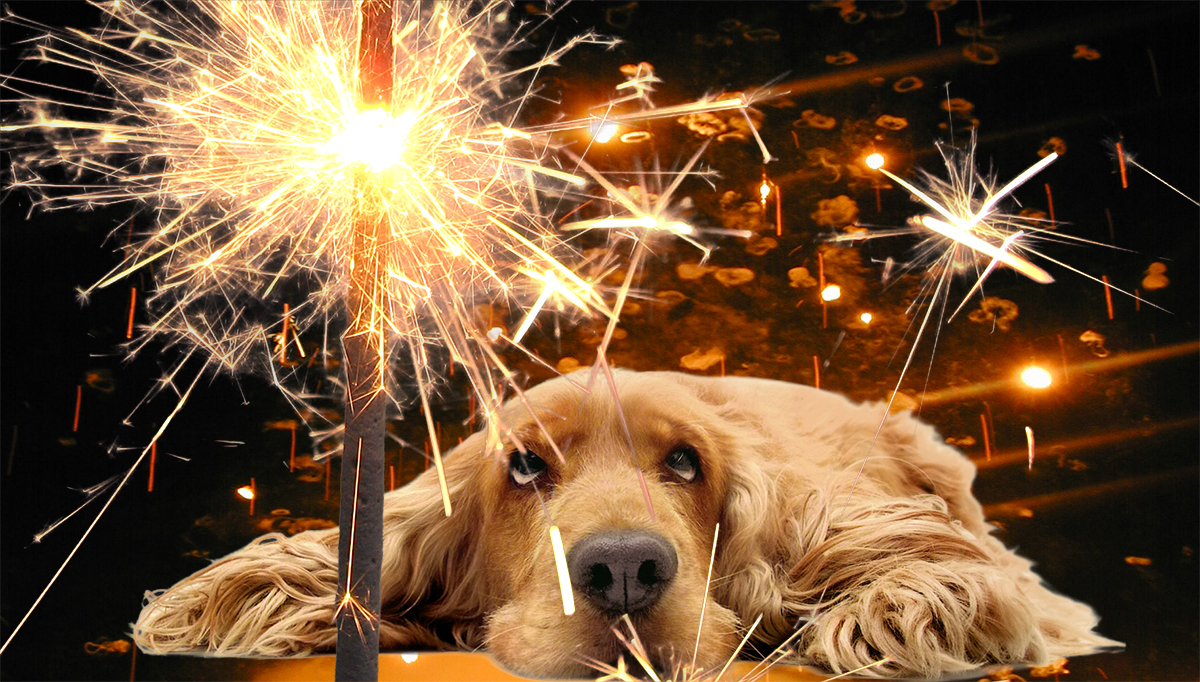
July 5th is consistently one of the worst days of the year for lost-pet shelter intake. It's not because dogs actually go missing more on that date. It's what happens the night before: gates left open, leashes slipped, chain-link clawed loose off the bottom of a kennel run by a dog that's been working at it for three hours straight. A dog steady on a duck blind with the boat motor idling can still come unglued by a bottle rocket two yards over, not from weakness, but because the night breaks every rule he's learned to trust.
Why Fireworks Hit Differently Than a Gunshot or a Storm
A dog's hearing range runs roughly twice as high as ours. A shotgun blast or a clap of thunder reads as a known event with a beginning and an end the dog can predict. Fireworks don't work that way. They come from different distances and directions, at intervals with no rhythm to them, for hours, sometimes across several nights in a row. A trained gun dog has learned that gunfire predicts a bird in the air. There's no payoff that makes sense of a sky full of noise on a random Tuesday in July.
Smell plays into it too. Sulfur and smoke don't match anything in a dog's normal world. That unfamiliar scent on top of the noise compounds the stress instead of explaining it away.
Signs Your Dog Is Past "A Little Jumpy"
Some of this is obvious: pacing, panting with no exertion behind it, trying to wedge into a bathtub or behind a toilet. Some of it gets missed. A dog that goes still and won't take a treat is often more stressed than one that's visibly shaking. Drooling that starts out of nowhere, dilated pupils, a tucked tail that doesn't come back up between bursts, a dog that suddenly wants to be plastered against your leg when he's never been a velcro dog. All of it is the same signal. Watch for a dog testing fence lines, door frames, or crate latches with his mouth or his paws. That's not bad behavior. That's a dog looking for an exit. A dog that finds one runs blind into traffic, a ditch, or open country, with no idea how to get back.
Two Dogs, Two Different Paths to the Same Problem
Trained to noise, not to chaos
A Lab or a GSP that's steady to wing and shot has learned gunfire as a predictable event tied to a job. Fireworks strip that predictability away. No birds, no pattern, no handler giving direction. Some hunting dogs handle it fine from general noise conditioning. Others, especially young dogs or dogs still building steadiness, react harder than you'd expect from a dog that doesn't flinch at a 12-gauge.
No prior reference point at all
A dog that spends most of his life on a couch or a quiet property has no context for a sky full of percussion. The first bad 4th of July often becomes the reference point for every one after. That's why getting ahead of it the first time matters more than damage control later.
A Week-Out Plan That Actually Helps
| Timing | What to Do |
|---|---|
| 7–10 days out | Confirm ID tags and microchip info are current. Check the yard or kennel run for any gap a dog under stress could work loose. Walk the fence line like you're the dog looking for the weak point. |
| 3–5 days out | If you're using a calming aid, vest, or anything new, introduce it now, not for the first time on the 3rd. A dog associating a new piece of gear with an already stressful night learns the wrong lesson fast. |
| Day of | Run the dog hard earlier in the day: a long retrieving session, a hard hike, real exercise that leaves him tired going into the evening. A worked dog has an easier time settling than a fresh one. |
| Day of, evening | Feed dinner early. Last potty break before dark, on leash, even for a dog that's normally fine off it. Close blinds or curtains on the side facing the noise. |
| During | Bring the dog inside, ideally a room without windows facing the show: a bathroom, a finished basement, an interior closet. Crate if the dog finds the crate calming; skip it if the crate has never been a safe space, since a panicking dog can hurt himself fighting it. |
| Next morning | Walk the fence line again. Check that gates latched, tie-outs held, and nothing got chewed through overnight. A dog that settled by midnight can still leave evidence of how hard the evening was. |
During the Show
Stay matter-of-fact. A dog reads tension in your voice and your body before he reads anything else. An owner who hovers and soothes in a high, worried tone confirms to the dog that something's actually wrong. Normal voice, normal posture, business as usual. White noise or a fan running helps flatten the sharp edges of the sound. If your dog wants to be near you, let him. Proximity isn't the same as reinforcing fear. A dog pressed against your leg is a dog you can keep an eye on.
Don't take a hunting dog or a house dog out to watch a fireworks show as a test of nerve. Real conditioning happens gradually, weeks ahead of time, at a volume the dog can handle, not by throwing him into the deep end on the one night of the year with the least room for error.
If a Dog Gets Loose
A spooked dog doesn't run toward home or familiar ground. He runs blind, away from the noise, with no sense of direction. Start the search at first light if the dog hasn't turned up by morning. A dog that ran scared overnight is often within a mile or two once it's calm enough to stop. Check with neighbors, local shelters, and any 4th of July-specific lost pet groups on social media right away. This is where current ID tags and a registered microchip do the most work of the whole year. A scared dog that won't approach a stranger will still get scanned if he ends up at a shelter or vet clinic.
Frequently Asked Questions
Why is my dog fine with thunder but terrified of fireworks?
Thunder builds gradually, with distant rumbles before a storm arrives, giving a dog time to adjust. Fireworks start without warning and come from unpredictable directions all night, which is harder for a dog to read or anticipate.
Should I crate my dog during fireworks?
Only if the crate is already a place your dog finds calming. For a dog that already views the crate as a den, it can help. For a dog that's never been comfortable crated, forcing it during a high-stress night can cause more harm than good. A frightened dog can injure himself trying to get out. A safe, enclosed room is usually a better call in that case.
Do calming vests and wraps actually work?
Many owners and trainers report real results from steady, even pressure on a dog's torso, similar to swaddling. It works better as part of a full plan that includes exercise, a secure space, and a calm handler than as a stand-alone fix.
Is it safe to give my dog Benadryl or another medication for fireworks?
Talk to your vet before giving any medication, including over-the-counter options. Dosing depends on your dog's weight, health history, and other medications, and a vet can also tell you whether a prescription option makes more sense for a dog with serious noise anxiety. This isn't something to figure out for the first time on the night of the 3rd.
My gun dog is steady to the gun, so why does he fall apart over fireworks?
Steadiness to gunfire is built around a pattern: a flush, a shot, a retrieve. Fireworks offer none of that structure. A dog can be rock solid in the field and still struggle on the 4th, and that's not a training failure so much as a different kind of noise entirely.
Will my dog grow out of firework anxiety?
For most dogs, noise sensitivity holds steady or gets worse with age rather than improving on its own. A consistent plan each year, and gradual desensitization work in the off-season with recorded firework sounds at low volume, does more than waiting it out.
What's the single most useful thing I can do this week?
Confirm your dog's ID tag and microchip information is current. Everything else on this list improves the evening. That one step is what gets a dog home if the evening goes wrong anyway.
Related Resources
- Dogs at Home
Bedding, containment, and everyday wellness gear for dogs on the home side of the bridge. - Off-Season Conditioning for Hunting Dogs
A worked, conditioned dog handles a stressful night better than one that's been sitting idle.
As always, our goal here at Dogs Unlimited is to help you Make Your Good Dog Better, including on the one night a year that has nothing to do with the field.