
GPS Tracking Collars for Hunting Dogs
GPS Dog Tracking Collars for Hunting: Find Your Dog in Any Terrain
A GPS dog tracking collar does one thing that no other piece of hunting equipment does — it tells you exactly where your dog is when you can't see it. For a wide-ranging pointer working a half mile of CRP grass, a retriever that marked a bird into a cattail marsh 200 yards out, or a hound running a track through timber at midnight, the GPS tracking collar is the difference between finding your dog and not finding your dog. It is among the most important investments a serious hunting dog owner can make.
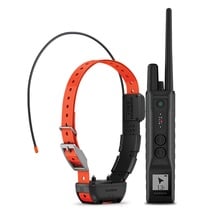
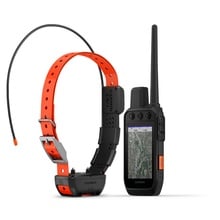
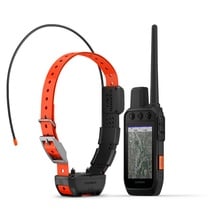
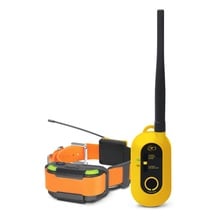
The GPS tracking systems below are built specifically for hunting dogs — not pet trackers with consumer-grade cellular coverage, but purpose-built VHF and GPS systems with the range, durability, and field-specific features that working dogs require. Garmin GPS tracking collars and Dogtra Pathfinder GPS systems cover every hunting application from close-working retrievers to hard-running all-age pointers. Questions about which system fits your dog and your hunting — call us at 800-338-36472. We've been doing this since 1971.
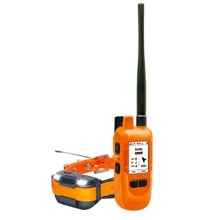
Hunting Dog GPS Tracker vs. Pet Tracker: Why the Technology Difference Matters
Consumer GPS pet trackers rely on cellular networks — they work well in suburban neighborhoods and urban parks, and fall apart in the river bottoms, timber, and remote prairie where hunting dogs actually work. A dog in a dead cellular zone is invisible on a cellular tracker. The hunting-specific GPS dog tracking systems we carry use GPS satellite positioning combined with radio frequency transmission that operates completely independent of cellular coverage. Range is measured in miles, not city blocks. Coverage works in the places your dog hunts, not just the places your phone has signal.
Hunting GPS systems also include features that consumer trackers don't offer: on-point alerts that notify you the moment your dog goes on point, real-time compass navigation that points you toward your dog on the handheld, multi-dog tracking from a single device, and combined GPS tracking and e-collar training capability in a single collar. These are not premium add-ons — they are the core functionality that makes a hunting GPS tracking collar worth carrying.
How GPS Dog Tracking Collars Work in the Field
A hunting GPS system is a two-device system — both the collar on the dog and the handheld carried by the hunter contain GPS receivers that independently receive signals from satellites. Here's how the data flows:
- Satellite positioning: Both the collar and the handheld receive signals from multiple satellites simultaneously — GPS, GLONASS, and other constellations depending on the system (Dogtra uses Multi-GNSS for enhanced positioning accuracy). Each device uses the timing differences between satellite signals to calculate its own precise position on the ground through trilateration.
- Radio frequency transmission: The collar continuously transmits its calculated GPS coordinates to the handheld via radio frequency — Garmin systems update at 2.5-second intervals; Dogtra systems update at 2-second intervals. This transmission operates independently of cellular networks and functions in remote areas with no phone signal.
- Position display: The handheld, knowing both its own GPS position and the collar's transmitted coordinates, calculates the precise direction and distance to the dog and displays both on a compass screen or map in real time.
- On-point detection: The collar's built-in accelerometer and movement sensors continuously monitor the dog's activity. When movement drops below the threshold that indicates a pointing dog — the dog has gone still on birds — the collar transmits an on-point status flag to the handheld, which alerts the hunter via tone, vibration, or on-screen notification.
In practice, the system gives you three pieces of information you use constantly in the field: where your dog is right now, what direction to walk to get there, and whether it's on point or still moving. For a pointing breed working out of sight in heavy cover, that information replaces minutes of searching with a direct line to the bird.
How to Choose the Best GPS Dog Collar for Hunting
Range is the most commonly cited specification — and the most commonly misunderstood. Manufacturer range figures are measured in line-of-sight conditions. Real-world range in timber, rolling terrain, and heavy cover is typically 30–60% of the stated maximum. For most upland and waterfowl hunters, even a real-world range of one to two miles is more than sufficient. Hound hunters covering big country should prioritize systems with the longest proven real-world performance and look for reviews from hunters working similar terrain.
GPS-only vs. combined GPS and e-collar is the first decision most buyers face. A GPS-only collar tracks location and delivers on-point alerts but has no training capability. A combined GPS and e-collar system does both from a single collar and a single handheld — locate the dog, receive on-point alerts, and deliver a training cue or recall without switching equipment. Garmin offers two combined system tiers: the Alpha 300 series is the full-featured platform with map display, 20-dog capacity, and up to 55-hour handheld battery; the Pro 550 Plus is the simpler one-handed tube-style platform with directional arrow tracking, 3-dog capacity, and 24-hour handheld battery for handlers who want straightforward GPS and training without a touchscreen. Both pair with the same TT25 and T20 collars. For most hunting dog owners, a combined system is the more practical choice. GPS-only collars are lighter and make sense as add-a-dog tracking collars for handlers who already own a combined system for their primary dog.
On-point notification alert settings matter for pointing breed hunters. Both Garmin and Dogtra systems allow you to customize how on-point alerts are delivered to the handheld — tone only, vibration only, or combined — so the alert suits your hunting environment without disturbing other hunters. The on-point detection itself is handled by the collar's built-in movement sensors, calibrated at the factory for reliable detection across different pointing styles and conditions.
Multi-dog tracking is essential for professional guides, hunt club operators, and anyone running more than one dog. The Dogtra Pathfinder2 Mini Compass stands out here — it tracks up to 21 dogs with a 2-second update rate and displays four dogs simultaneously on the handheld screen, at a price point significantly below comparable Garmin multi-dog setups. Garmin's Alpha 300 series also handles up to 20 dogs from a single handheld with individual on-point alerts for each. The Pro 550 Plus handles up to 3 dogs. Confirm the specific model's multi-dog capacity before purchasing — this detail matters significantly for guides and hunt clubs.
Battery life varies significantly between systems. The Garmin Alpha 300 handheld runs up to 55 hours; the Pro 550 Plus runs up to 24 hours. Both pair with the TT25 and T20 collars, which use Dynamic Tracking to extend collar battery life to up to 68 hours standard or up to 136 hours with the extended battery pack — meaning a Garmin collar can run three to five days in the field without a charge. The Dogtra Pathfinder2 Mini Compass uses USB-C fast charging; plan for nightly charging on multi-day hunts or carry a portable charging solution for all-day hunting in remote country.
Frequently Asked Questions: GPS Dog Tracking Collars for Hunting
What is the best GPS collar for hunting dogs?
The right system depends on your hunting application and budget. The Garmin Alpha 300 series is the most fully featured platform — map display, 20-dog capacity, 55-hour handheld battery, and inReach satellite messaging on the 300i. The Garmin Pro 550 Plus offers simpler directional tracking for up to 3 dogs in the proven tube-style design at a lower price point. The Dogtra Pathfinder2 Mini Compass is the strongest value in the category — 21-dog capacity, 100 stimulation levels, 2-second update rate, IPX9K waterproofing, and a standalone handheld that requires no phone. Call us at 800-338-3647 and we'll help you match the right system to your dog and discipline.
How far can a GPS dog collar track?
Manufacturer range figures are measured in ideal line-of-sight conditions. Real-world range in hunting terrain — timber, rolling hills, river bottoms, and heavy cover — is typically 30–60% of the stated maximum. Most upland hunting situations are well within the real-world range of current systems. Hound hunters covering large territory should prioritize the highest stated range and look for reviews from hunters working similar terrain. Garmin's Alpha series consistently delivers the longest real-world range in field testing. The Dogtra Pathfinder2 Mini Compass paired with the standard Pathfinder2 collar reaches up to 9 miles; paired with the mini collar, up to 4 miles.
Do I need a GPS collar if I already have a beeper collar?
They serve different purposes and work best together. A beeper collar gives you audible feedback — you can hear the dog's location and on-point status without looking at a screen. A GPS collar gives you precise location data on a compass or map, directs you to the dog in cover where you can't hear the beeper, and tracks movement history. Many serious upland hunters run both: the beeper for real-time audible notification when the dog is within earshot, and GPS for locating a dog that has ranged beyond hearing range or gone on point in heavy cover where sound doesn't carry.
What's the difference between a GPS hunting collar and an LTE tracker?
A hunting GPS collar uses satellite positioning and radio frequency to transmit your dog's location directly to a dedicated handheld — no cellular coverage required, no monthly subscription, and reliable performance in remote areas. The collar and handheld both receive GPS satellite signals independently; radio frequency links the two devices together. An LTE tracker calculates location via GPS but routes that data through cellular towers to a smartphone app — it works anywhere with cell service but fails in the remote terrain where hunting dogs work. For serious hunting applications, purpose-built hunting GPS systems are the correct choice.
How does on-point notification work on a GPS hunting collar?
The collar's built-in accelerometer and movement sensors continuously monitor the dog's activity. When the dog's movement drops below the threshold that indicates a stationary pointing posture — the dog has stopped and locked up on birds — the collar transmits an on-point status flag to the handheld. The handheld alerts the hunter via tone, vibration, or on-screen notification depending on the alert settings the hunter has configured. Both Garmin and Dogtra systems allow you to customize how the alert is delivered, so you can choose the notification method that suits your hunting environment without creating unnecessary noise in the field.
Can I track multiple dogs with one GPS system?
Yes. The Dogtra Pathfinder2 Mini Compass tracks up to 21 dogs with four shown simultaneously on the handheld screen — the strongest multi-dog value in its price class. Garmin's Alpha 300 series tracks up to 20 dogs simultaneously with individual on-point alerts for each. The Pro 550 Plus handles up to 3 dogs. If you run more than three dogs, the Alpha 300 or Pathfinder2 Mini Compass are both proven multi-dog systems — call us to compare them for your specific situation.
Does a hunting GPS collar require a subscription?
No — hunting GPS systems from Garmin and Dogtra require no monthly subscription. You purchase the hardware and it works without ongoing fees. The Dogtra Pathfinder2 Mini Compass includes the free PF2 app with offline maps, GPS fencing, and enhanced mapping features at no additional cost. Garmin's Alpha 300i includes inReach satellite messaging which requires a separate subscription for that specific feature — but the core GPS tracking and training functions require no subscription on any Garmin hunting system.
Related Resources
- Dog Bells & Beeper Collars — audible on-point notification that works alongside GPS in heavy cover
- GPS & E-Collar Accessories — add-a-dog collars, replacement contacts, and charging gear
- LED Beacon Collars & Low-Light Tracking Gear — high-visibility equipment for locating dogs in low light
- Upland Hunting — GPS tracking for pointing breeds and flushing dogs in the field
- Waterfowl Hunting — waterproof GPS systems for retriever work in cold-water conditions
- Hunting Dog Training Activities & Season Guides — training resources for every discipline and season
Since 1971, Dogs Unlimited has helped serious hunters find the right GPS tracking system for their dogs and their hunting. Whether you're running one pointing breed in the uplands or a pack of hounds through big timber, we carry systems that work in the real field. Questions? Call us at 800-338-3647 — we're hunters too.