
Honoring: Teaching a Bird Dog to Back Another Dog's Point
Monday, August 3rd 2026
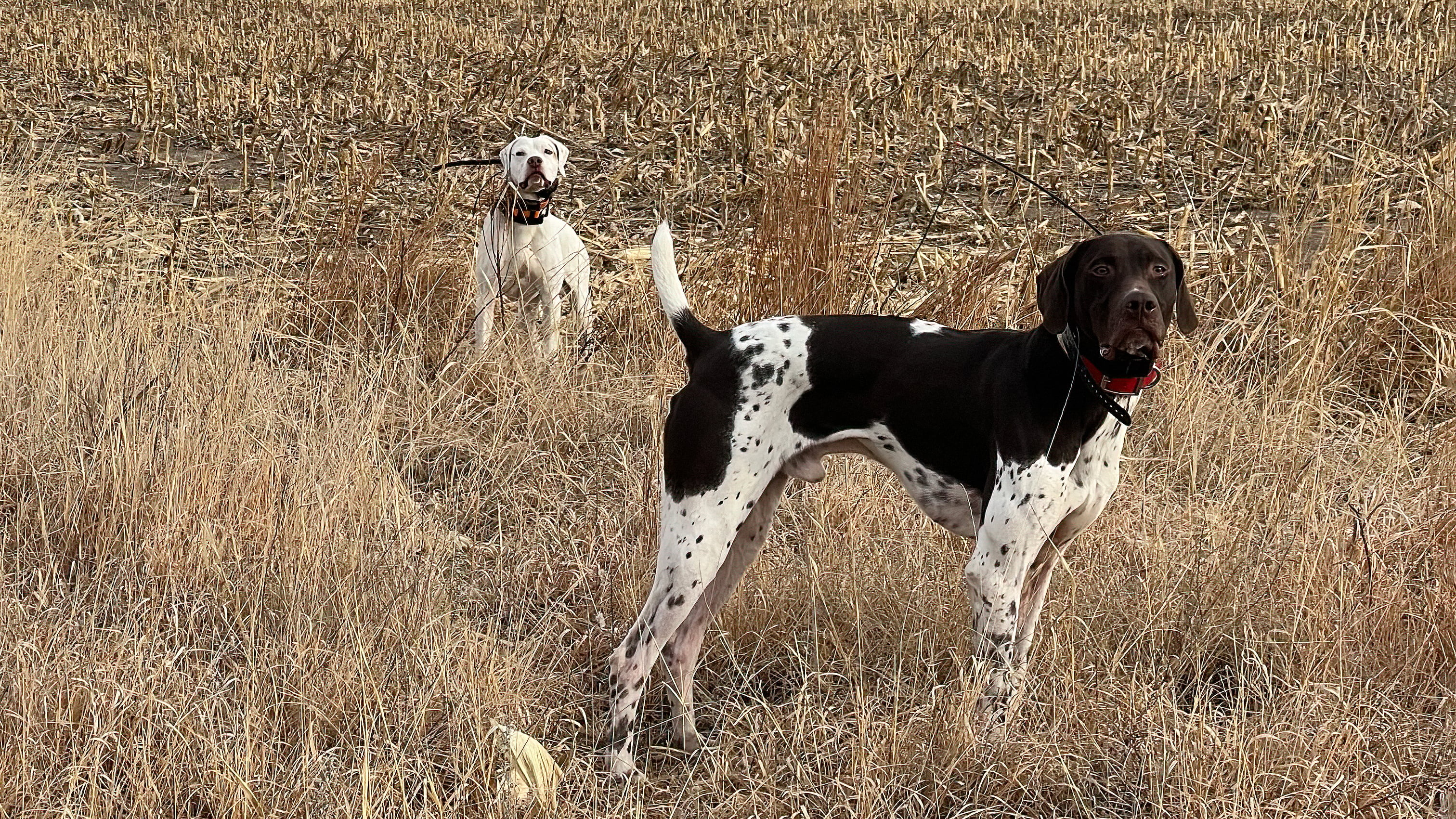
Two pointing dogs are working the same field. One locks up on a covey. The other, thirty yards out, sees it happen and stops too, without a word from either handler. That second dog just honored the first. It never smelled that bird, never worked in on it, and stopped anyway, because another dog's point is enough of a signal on its own.
A dog can hold a rock-solid whoa and still have never learned to honor. That dog will run straight through another dog's point and flush the bird itself. Whoa was never the issue. The dog simply has no reason to think another dog's point applies to it, and most hunters don't find that out until they're standing in a field with someone else's dog locked up and their own dog barreling in.
Why Honoring Matters
A dog points so it doesn't interfere with what it's found: it holds still, the bird holds still, and the hunter has time to get into position for a clean shot. Honoring is that same principle extended to another dog's find. When one dog backs another's point instead of crowding in, both dogs stay out of each other's way and the hunter gets the same fair chance at the bird. It is, in the truest sense, one dog showing another dog respect in the field.
Without it, that whole system breaks down. A dog that won't honor can push straight through another dog's point, and most upland species hold in coveys, so disturbing one bird often flushes the whole group wild and out of range before anyone is close enough to shoot. The pointing dog, watching another dog crash the moment it worked hard to build, may break and chase right along with it. What was a clean, controlled find becomes chaos for both dogs and both hunters. Honoring is what keeps that moment intact.
What Should Already Be in Place
Whoa needs to be solid without another dog anywhere nearby: reliable through a flush, reliable at distance, holding on real birds without a hand on the cord. If your dog is still breaking on its own points, honoring will only teach it that breaking sometimes gets corrected and sometimes doesn't, which undermines everything built in the earlier stages of this series. Get the foundation covered in Steadying a Bird Dog locked in first.
You'll also need a second dog for this work: one that's already steady and experienced enough to hold a point reliably while a young dog approaches. Borrow one if you need to. Training honoring with two green dogs teaches nothing but chaos.
Building the Skill
The Setup
Plant a bird and let your steady dog find and hold point. Bring the dog in training toward that point on a check cord, approaching from an angle where it can see the other dog clearly. The instant your dog notices the other dog on point, say whoa. You're asking for the exact same response you already built in yard work: the command is old, the trigger is new.
The Correction
This is where a whoa hitch earns a place in the program that the check cord alone doesn't cover. It snaps to the dog's collar, wraps around the dog's belly, and clips off to a floating O-ring, giving you a connection point around the body instead of just the neck. If the dog starts to push forward toward the other dog's point, that connection lets you caution it immediately, or physically lift and reset the dog back into position without wrestling a collar or a check cord. The same hitch can also clip to a belt loop as a simple hands-free lead for everyday handling, but that's a different use case from the correction work described here.
Reinforcing with the E-Collar
Once the dog is reliably honoring with a handler close enough to correct by hand, a system like the Garmin Sport PRO lets you back up that same correction at real hunting distance, where you won't have a check cord or a hand anywhere near the dog. Since the whoa hitch has already built the dog's association with pressure around the belly rather than the neck, some trainers run the e-collar's own strap around the belly instead of the neck, so the correction lands where the dog already expects it. A light stim at the exact moment the dog starts to break transfers the correction from hand to collar. Introduce it only once the behavior is already understood, the same rule that applied when the collar was added to plain whoa work.
Common Mistakes
Timing trips up more dogs here than anything else. Start honoring before whoa is fully proofed on its own and you're layering one unfinished skill on top of another. The dog you borrow matters just as much: if the "steady" half of the pair breaks or reacts, the dog in training learns that points don't actually have to be held, and that lesson undoes everything else in one afternoon. Correction has to be consistent, every time the dog breaks, not most times. A dog that gets away with it even once in ten tries has learned that breaking sometimes pays off, and it will keep trying to find that gap again.
Recommended Training Video
Training the Bird Hunter's Bird Dog, a 90-minute program by nine-time National Bird Hunter Handler of the Year Scott Miller, covers this exact stage: e-collar timing, holding point, and backing another dog's point, filmed on his training grounds so you can watch real corrections happen in real time rather than trying to picture them from a written description.
Frequently Asked Questions
What does honoring mean in bird dog training?
Honoring, also called backing, is when a dog stops and points as soon as it sees another dog on point, instead of running in and disturbing the bird or the other dog's work.
When should I start teaching a dog to honor?
Only after whoa is solid on its own, with no other dog involved. You aren't teaching a new command. You're testing whether whoa holds up against a temptation, another dog's point, that the dog hasn't faced before.
Do I need a trained dog to teach honoring?
Yes. You need at least one steady, experienced dog to hold a point while the dog in training approaches. An older, reliable dog that won't break or react is what makes the setup safe to run repeatedly.
What is a whoa hitch and how does it work for honoring?
It snaps to the dog's collar, wraps around the belly, and clips off to a floating O-ring, giving the handler a connection point around the body instead of just the neck. This lets the handler caution a dog that starts to break, or physically lift and reset it back into position.
My dog honors sometimes but runs in other times. What's wrong?
Inconsistent honoring usually means the underlying whoa isn't fully proofed yet, or the dog hasn't had enough reps in the exact setup: seeing another dog locked on point and being expected to stop too.
Can any pointing breed learn to honor?
Yes. English Pointers, German Shorthaired Pointers, Brittanys, Vizslas, English Setters, and German Wirehaired Pointers all learn honoring the same way, through a solid whoa foundation and repeated exposure to another dog's point.
Does a dog need to honor if I only hunt alone?
It still matters. Group hunts, guided trips, and hunt tests all put your dog around other dogs on point, and a dog that hasn't learned to honor will run in and flush birds another dog is already holding, ruining the work of a dog that did everything right.
Related Resources
As always, our goal here at Dogs Unlimited is to help you Make Your Good Dog Better, one point held and one point honored.